1983 World Cup Hero Kirti Azad Exposes Fake Celebration Bill, Claims Kapil Dev’s Signature Forged

1983 World Cup Winner Kirti Azad Confirms Viral Celebration Bill is Fake
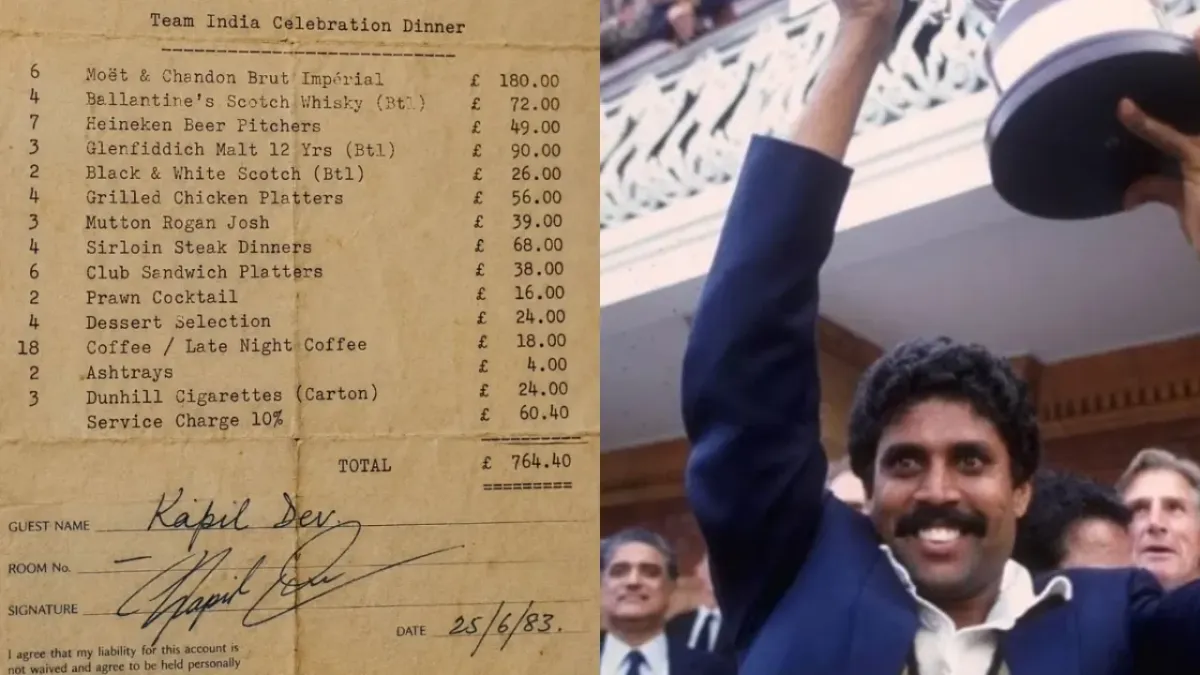
In a move that has put to rest a growing online myth, former Indian cricketer Kirti Azad has categorically denied the authenticity of a viral document claiming to be the 1983 World Cup victory celebration bill from the Grosevenor Hotel in London. As speculation spread across social media platforms, Azad, a key member of India’s historic World Cup-winning squad, stepped forward with a firm rebuttal.
“We Stayed at Westmoreland, Not Grosevenor”
Azad shared the disputed image on his social media account and labeled it as fake. “This is fake. It is all over social media. We stayed at Westmoreland Hotel, next to Lord’s Cricket Ground, London,” he stated. He emphasized that the celebrations following India’s monumental win on June 25, 1983, lasted through the night until the early morning of the 26th—but entirely within their actual hotel premises.
“We never went to this hotel,” Azad added, referring to the Grosevenor Hotel mentioned in the document. His clarification comes as a crucial firsthand account from someone who was not just a spectator, but a participant in one of the most defining moments in Indian cricket history.
Signature Under Scrutiny
Beyond the location discrepancy, Azad raised serious concerns about the signature on the bill, which purportedly belongs to then-captain Kapil Dev. “The signature of Kapil Dev is also forged,” he asserted.
Former Indian spinner Laxman Sivaramakrishnan supported Azad’s claim. Responding to the post, Sivaramakrishnan wrote: “Kapil Dev doesn’t sign that way.” The comment quickly gained traction, reinforcing doubts about the document’s legitimacy.
The Real Story of India’s 1983 Triumph
The 1983 ICC Cricket World Cup remains a landmark event in sports history. Under Kapil Dev’s fearless leadership, the Indian team defied all odds to clinch the title—a victory that reshaped the trajectory of Indian cricket.
The campaign began with a stunning 34-run win over the two-time defending champions, the West Indies, in Manchester. After a setback against Australia and a narrow loss in the return match against the Windies, India rallied with a legendary 175 not out from Kapil Dev against Zimbabwe—a knock widely regarded as one of the greatest in ODI history.
Path to the Final
Madan Lal and Roger Binny delivered a devastating bowling performance against Australia in their second meeting, each claiming four wickets to secure a commanding 118-run victory. In the semifinal, fifties from Yashpal Sharma and Sandeep Patil steered India to a six-wicket win over England at Manchester.
In the final at Lord’s, India was bowled out for just 183, with Krishnamachari Srikkanth top-scoring with 38. But in a remarkable turnaround, the Indian bowling attack, led by Mohinder Amarnath and Madan Lal—who took three wickets each—dismantled the West Indies for 140, sealing a 43-run victory.
Legacy of Kapil’s Devils
The team, affectionately dubbed “Kapil’s Devils”, didn’t just win a trophy—they ignited a nation’s passion for cricket. The 1983 victory laid the foundation for India’s future dominance in the sport and inspired generations of cricketers.
Now, nearly five decades later, the legacy continues to be protected by those who lived it. Kirti Azad’s intervention serves as a timely reminder: while nostalgia can be powerful, facts matter most—especially in preserving history.
As the digital world circulates more unverified content than ever, firsthand testimonies like Azad’s are invaluable in separating truth from fiction.